Broken Spring Replacement in Provo, UT
Provo has the oldest housing of the four cities, with close to half of it built before 1980. That's why a broken spring here is more likely than anywhere else to involve springs stretched along the side tracks rather than wound above the door, and why the first thing checked is whether a safety cable runs through them.
Ask Clark about this job
Tell Clark what the door is doing and he will call you back himself.
Broken Spring Replacement · Utah County
An extension spring lets go all at once.
An extension spring stretches along the horizontal track on each side of the door and pulls through a set of pulleys as the door comes down. When one fails it doesn't simply stop working. It releases everything it was holding at once, and the spring, the pulley and the hardware on the end of it are suddenly free to move. That's the entire reason a containment cable exists: a steel cable run through the middle of the spring and anchored at both ends, so a spring that snaps gets caught rather than thrown.
Provo's housing stock is where you find them missing. Plenty of older installs predate the point at which containment cables became routine, and a cable that was fitted can be taken off during a later repair and never put back. In a city where close to half the homes went up before 1980, that check isn't a formality. If your springs run along the tracks, look down the length of each one. A containment cable passes through the center of the coil, not beside it. If nothing is threaded through the middle, say so when you call.
None of that means every old Provo door is on extension springs. Many run torsion on a shaft above the opening, either because the door was always a heavier sectional or because somebody converted it at some point. The link between age and spring type follows door weight and price tier as much as build year, so it tells you what to expect rather than what you've. A heavy modern door hung in a 1970s opening is an ordinary thing to find in this city.
The oldest doors here aren't sectional at all. A one piece door pivots on hardware bolted to the jambs and swings outward at the bottom as the top goes up, and its springs mount to that jamb hardware rather than to a shaft or a track. It's a different repair with different parts, and some of those parts haven't been made for a long time. Where a spring for one can still be sourced, replacing it's straightforward. Where it can't, the honest answer is a conversation about the door rather than about the spring, and you get that answer before anything is ordered.
On a door with forty years on it the spring is rarely the only part at the end of its life. Pulleys wear out their bearings. Extension spring hardware corrodes at the bottom, where water off the car sits against it. The hooks and clips holding the assembly together fatigue on the same schedule the spring does. The inspection is free and it covers all of that, so what you hear is what actually failed and what is queued up behind it.
Before you call · Broken Spring Replacement
Signs the spring is what broke
- A loud bang from the garage, then a door that won't open
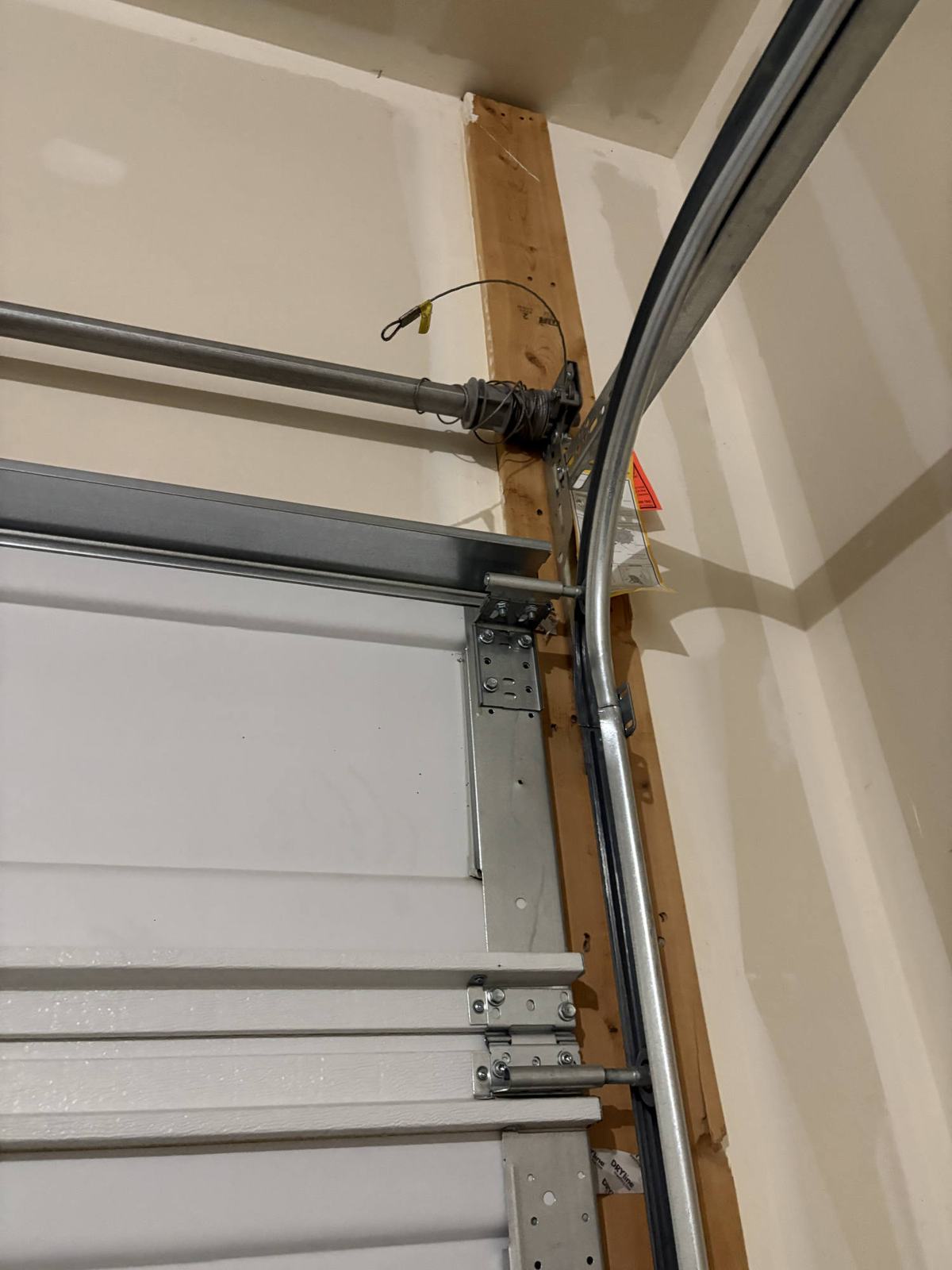
- A visible gap of an inch or two in the coil on the shaft above the door
- The opener strains, hums, or moves the door an inch and stops
- The door lifts a few inches by hand then feels impossibly heavy
- The door opens crooked, with one side higher than the other
- A spring lying on the garage floor or hanging loose beside a horizontal track
- The emergency release cord pulls, but the door still won't lift by hand
Why this isn't a do it yourself job
- A wound torsion spring holds enough stored energy to break bones. It's released with winding bars sized for that spring, never with a screwdriver or a length of rebar
- The bottom brackets at the base of the door are under full spring tension even when the door is down. They are the single most dangerous fastener on a garage door
- Springs are sized by wire diameter, inside diameter, length and wind direction. The wrong size does lift the door, badly, and then fails early
Why this job goes to Clark
Get the door lifting again.
Both springs, not just the broken one
On a two spring door, the surviving spring has the same age and the same cycle count as the one that just let go. Replacing the pair is the repair that lasts.
The cables get checked too
A spring that lets go often puts slack in the lift cables and can pull one off the drum. That gets looked at in the same visit rather than becoming next week's call.
A straight explanation first
You get told what failed and why before anything is touched. Repair first, and no unnecessary upsells.
Questions · Utah County
Broken Spring Replacement FAQ
How do I tell whether my extension springs have safety cables?
Look along the length of each spring with the door closed. A containment cable runs through the middle of the coil and is anchored at both ends, so you'll see it passing inside the spring rather than lying next to it. If the only thing there's the spring itself, nothing is in place to catch it when it goes.
My Provo door is one piece and swings outward. Can its springs be replaced?
Sometimes, and it depends entirely on what hardware is on it. One piece doors pivot on jamb mounted fittings and the springs attach to those rather than to a torsion shaft, so the parts are specific to that design. Some are still available and some haven't been produced in decades. That gets checked before anything is promised.
Why do so many older Provo doors use a different spring setup?
Because those doors were lighter. One piece and early sectional doors didn't weigh what a modern insulated sectional weighs, and extension springs along the tracks were an ordinary way to counterbalance them. Heavier doors moved to torsion above the opening. The split follows the weight of the door, which is why budget sectional doors are still fitted with extension springs now.
Should I convert to torsion springs?
It's worth asking about rather than assuming either way. Torsion has real advantages on a door that can take it, including tighter control of the door and a straightforward place to put a containment system. It also needs room above the opening for the shaft, and plenty of pre 1980 Provo garages are tight on that. The measurement settles it, not the preference.
What customers say
I had a broken garage door spring this morning, and Clark saved the day. He arrived promptly, diagnosed the issue right away, and took the time to explain everything clearly. He is incredibly professional, patient, and skilled at what he does.Thanks, Clark!
Related services · Utah County