Garage Door Tune-Up and Maintenance in Utah County
Prevent breakdowns, reduce noise, and keep your door running safely year-round. Most of the emergency calls Clark takes started as something a tune-up would have caught.
Ask Clark about this job
A short description of what the door is doing is usually enough.
Garage Door Tune-Up · Utah County
Two tests tell you most of what you need to know.
The balance test is the first one and you can do it today. Close the door, unplug the opener, and pull the red emergency release cord so the door is disconnected from the trolley. Lift the door by hand to about waist height and let go. A correctly balanced door stays roughly where you put it. If it slides down, the springs have weakened and the opener has been making up the difference. If it pulls itself upward, the springs are wound too tight. Either way the opener is doing work it was never designed to do, and it will fail early.
The safety reversal test is the second. With the door reconnected, lay a flat obstruction on the floor in the doorway, something solid like a length of two by four laid flat. Close the door with the button. When it touches the obstruction it must stop and reverse. Then test the photo eyes: start the door closing and wave something through the beam near the floor. It must reverse. A door that fails either test is unsafe around children, pets and vehicles, and that's the thing a tune-up exists to catch.
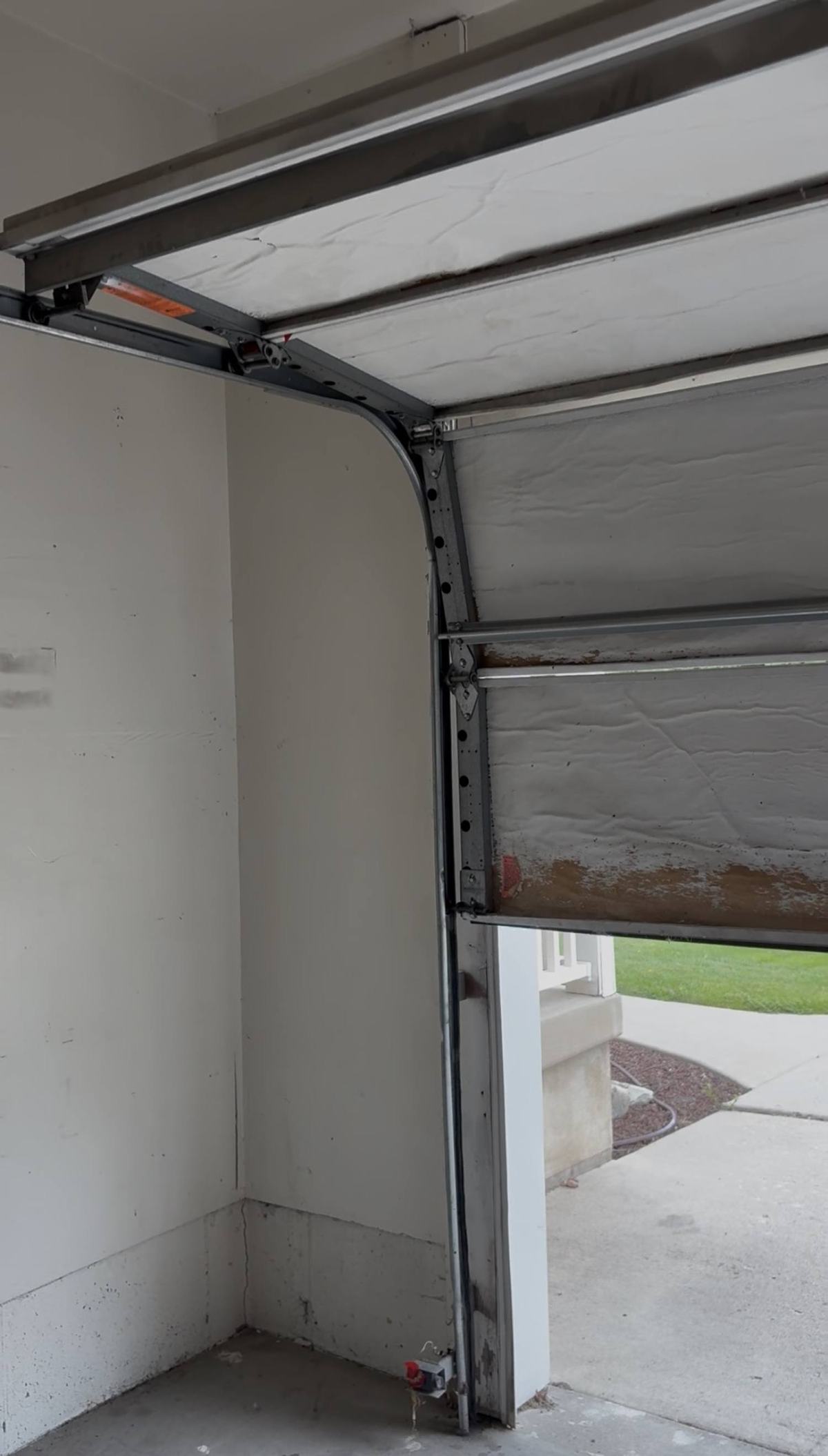
The rest of a tune-up is hardware. A garage door vibrates every time it runs, and vibration loosens fasteners. Lag bolts in the track brackets, the bolts on the opener rail hanger, hinge screws in the section stiles and the nuts on the bottom brackets all back out slowly. Once a track bracket is loose the track drifts, once the track drifts the roller binds, and once the roller binds you're on the way to an off track door. Tightening everything is fifteen unglamorous minutes that prevent an expensive afternoon.
Lubrication is where most homeowners go wrong, and it's worth being specific. Use a garage door lubricant, either a lithium based grease or a silicone spray made for the job. Don't use WD-40. It's a solvent and a water displacer, so it strips the grease out of bearings and leaves them dry, which is the opposite of maintenance. What gets lubricated: hinge pivot points, roller bearings, the torsion springs themselves, the end bearing plates and center bearing, the opener rail and, on a screw drive, the screw. What never gets lubricated: the inside face of the track, because it's a running surface and oil there just collects grit.
Winter is what makes this matter in Utah. Cold steel is more brittle, grease thickens, and a spring already near the end of its cycle life very often chooses the first hard freeze to let go. A door checked in the fall goes into winter with tight hardware, lubricated bearings and springs that have actually been looked at.
Before you call · Garage Door Tune-Up
What a tune-up covers
- Balance test with the door disconnected from the opener
- Safety reversal test on contact, and a photo eye beam test
- Spring condition, and the door's cycle history where it can be read
- Cable inspection along their full length, especially near the bottom brackets
- Roller condition and bearing play on every roller
- Hinge condition, cracked stiles and elongated screw holes
- Track alignment, plumb and spacing, and every track bracket retightened
- Opener travel limits, up and down force, chain or belt tension
- Lubrication of hinges, bearings, springs and rail with the correct product
- Bottom seal and perimeter weather seal condition
What a tune-up isn't
- It's not a parts replacement. Anything found worn gets explained and quoted, and you decide
- It won't rescue a spring that has already reached the end of its cycle life. It will tell you that it's close, which is the useful part
- It doesn't cover cosmetic panel damage or repainting
Why this job goes to Clark
Get ahead of the next breakdown.
Catch the spring before it goes
A spring near the end of its cycle life can often be spotted before it snaps. That turns a scheduled visit into the repair instead of an emergency.
Tight hardware, quiet door
Most rattles and bangs are loose lag bolts and dry bearings rather than anything broken. Both get fixed in the same visit.
The safety tests actually get done
Contact reversal and photo eye reversal are the two tests that matter around kids and cars, and they're the two most often skipped.
Questions · Utah County
Garage Door Tune-Up FAQ
How often should a garage door be serviced?
Once a year suits most households, and going into fall is the sensible time in Utah, because cold weather is what finishes off a tired spring. A door that runs many times a day, or a detached garage exposed to more weather, is worth looking at more often than that.
How do I test the balance myself?
Close the door, unplug the opener, pull the red release cord, lift the door to about waist height and let go. If it holds position, the springs are doing their job. If it slides down or pulls up, they aren't, and the opener has been compensating. Reconnect the trolley afterward.
What lubricant should I use?
A lithium grease or a silicone spray sold for garage doors. Not WD-40, which is a solvent that strips the grease out of bearings and leaves them dry. Lubricate hinges, roller bearings, springs, bearing plates and the opener rail. Leave the inside of the track alone.
My door works fine. Is a tune-up worth it?
A door that works fine and a door that's about to fail look identical from the kitchen. Frayed cables, cracked hinges and an out of balance door all run normally right up until they don't. The point of the visit is to find those while they're still small.
What customers say
Wonderful experience. I moved into a house with a really loud and squeaky garage door. Clark had it tuned up and QUIET in no time!
Related services · Utah County