Garage Door Opener Repair in Orem, UT
The median Orem home was finished in 1989, two years before an opener had to reverse on its own and four years before photo eye sensors were required. Most of those original motors are long gone. The garage they were fitted into hasn't changed, and that's what shapes an opener repair here.
Ask Clark about this job
Tell Clark what the door is doing and he will call you back himself.
Garage Door Opener Repair · Utah County
Two dates decide what your opener has.
Two dates matter and the order of them matters. Residential openers had to carry inherent entrapment protection, meaning the motor senses resistance and reverses by itself, from the first day of 1991. The photo eyes near the floor came later, required from the first day of 1993, and they were added as a second layer rather than as a substitute for the first. A compliant opener has both. Which of them a given unit was built with tells you most of what can be done to it.
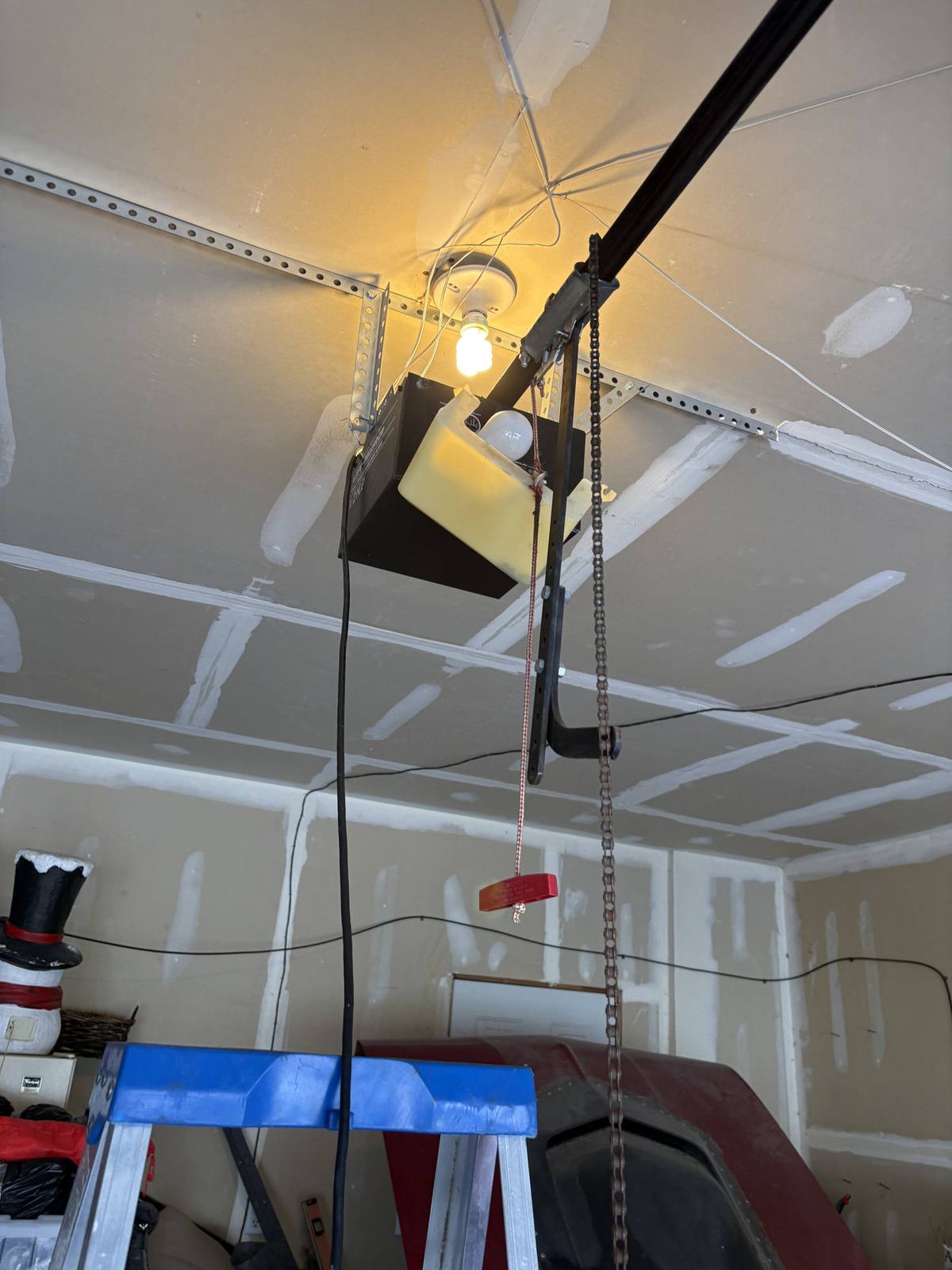
Very few original 1980s motors are still turning, because they have had thirty five years in which to fail. What is usually hanging in an Orem garage is a second or a third unit, fitted somewhere in the nineties or later, into a garage that was never wired or framed for one. That's the source of most of the electrical faults on this repair in this city. The sensor wiring is a retrofit, the run was made long after the walls were finished, and it shows.
Consider what that retrofit involves. Photo eyes have to be fed low voltage wire from the motor head down to floor level on both sides of the opening. Done well that's a tidy stapled run along framing. Done in a hurry it's a wire pulled tight around a corner, a staple driven hard enough to bite into the insulation, a splice made with a twist and some tape where the run came up short, or a length crossing a doorway where it eventually gets caught. Every one of those faults behaves exactly like a blocked beam, so the sensors get blamed, get swapped, and the problem comes straight back.
Then there's the case where repair stops being the answer. If what is on your ceiling genuinely is the original motor, there's a limit to what any repair can do. A unit built before 1991 wasn't required to sense an obstruction and reverse at all, and no part adds that. A unit built between 1991 and 1993 has the reversal but may have no terminals on its board for external sensors, which means photo eyes can't simply be wired on. Repair first is the default and it stays the default. On a motor with no entrapment protection at all, saying so plainly is the more useful service.
An opener that struggles is often reporting on the door rather than on itself, and on a door with thirty five years of travel behind it that's the way to bet. Dry bearings on the torsion shaft, rollers that skid instead of rolling, and track that has drifted as the lag bolts worked loose all make the door harder to move. The opener reads harder to move as an obstruction and behaves like a failed unit. That's why the free inspection covers the whole assembly and not only the box on the ceiling.
Before you call · Garage Door Opener Repair
Opener faults Clark sees most
- Motor runs and hums but the door doesn't move, which is normally a stripped gear
- One click and then nothing at all
- The door starts to close, then stops and goes back up
- The door stops a few inches short of open or closed
- The wall button works but the remotes don't, or the remotes are intermittent
- Grinding, rattling or a loud bang as the door runs
- The trolley moves but the door stays where it's, which means the arm or trolley let go
- The opener runs the door crooked, or shudders on the way up
Worth knowing before you call
- A door that's out of balance will destroy a new opener in short order. If the springs are weak, that gets said up front rather than discovered after the motor is hung
- New wiring for a dedicated circuit or an outlet in the ceiling is electrical work and belongs to an electrician, not a door tech
- A unit that's decades old, out of production and short on parts sometimes can't be repaired. You get told that plainly, including when the honest answer is that repair isn't the right call
Why this job goes to Clark
Get the door answering the button again.
The whole door gets checked
Springs, cables, rollers and track alignment are all looked at, because an opener fights a door that's out of balance and then gets blamed for it.
Symptom to part, not guesswork
A hum is a different repair from a click, and a reversal on close is a different repair from a stop on open. The symptom narrows it before anything comes apart.
Repair before replacement
Gears, capacitors, trolleys, sensors, rollers and logic boards are ordinary repairs. A new opener is a decision, not a default.
Questions · Utah County
Garage Door Opener Repair FAQ
My Orem opener has nothing mounted near the floor. Can sensors be added?
It depends on the motor rather than on the garage. A unit whose logic board has terminals for external sensors can usually take a retrofit pair, wired and aligned properly. A unit built before those terminals existed can't, and no adapter changes that. Where retrofitting isn't possible the honest answer is a different unit rather than an accessory, and you get it before anything is ordered.
The sensors were replaced and the door still reverses. What now?
In an older garage that usually means the wire rather than the eyes. Sensor wiring in an Orem garage is nearly always a retrofit run added long after the building went up, and a staple through the insulation, a corroded terminal screw or a taped splice all behave exactly like a blocked beam. The run gets traced before another pair goes on.
Is my opener worth repairing or should it be replaced?
Gears, capacitors, boards, trolleys and sensor pairs are ordinary repairs and worth doing on any unit with parts still available. What changes the answer in this city is whether the unit has entrapment protection at all, because a motor that predates the 1991 requirement can't be given it. That's a replacement question rather than a repair question, and it's the one place where repair first runs out of road.
The opener strains but the door isn't stuck. Is the motor failing?
Usually not on a door this age. A late eighties door with dry shaft bearings, worn rollers and track that has drifted takes far more force to move than it did when it was new, and the opener is simply reporting that. Fixing the door is what fixes the opener's behavior. A new motor bolted over the same problem will do the same thing.
What customers say
10/10 highly recommend! I’ve been dealing with a frustrating garage door issue for over a year, having to literally get out of my car, walk inside, and hold down the wall button just to open the door. Clark came out today and fixed it in literally 10 minutes. He was fast, professional, and completely resolved a major headache. If you need garage door service, definitely give them a call!
Related services · Utah County